.png)
Published: 5 June, 2026
- Share
-

-

-

Even if your SEO is working, you may be experiencing a drop in organic traffic. When this post first ran in 2021, the warning was that Google was quietly keeping more and more search traffic for itself.
That warning aged well.
Today, 56% of Google desktop searches end without a click to another website, and the rate on mobile is higher still. Then Google rolled out AI Overviews, and the floor moved again.
But no, that doesn't mean SEO is dying. The version of SEO that treated month-over-month traffic as the whole scoreboard, though, is likely finished. And there's a strong chance the search that brought you to this page never showed you a list of blue links at all.
The forces behind that drop have been building for years, and almost all of them lead back to one company, and now to the AI sitting on top of its results. Here's how the squeeze happened, and what still works.
Competition has increased
There are very few barriers to entry to get your site online and as a result, most companies have a website.
Some of these will be direct competitors to you for your products and services while others will not be business competitors but WILL be keyword competitors, fighting for search engine positioning for the same keyword phrases.
That's the baseline pressure: more sites chasing the same finite set of ranking positions every year.
Year-over-year audience growth has slowed
In previous years, we've seen incredible adoption of internet use and more people using the internet contributes to more potential for website traffic.
While those numbers continue to grow, the pace has slowed only because we've hit a pretty impressive adoption rate for internet use and there isn't too much more room here to grow.
Even our children have internet access and conduct multiple searches per day when they're on YouTube or asking a home assistant questions.
There's a newer wrinkle on top of that plateau: a lot of those "searches" don't happen on Google anymore. People ask ChatGPT, they ask Gemini, they ask the assistant in their car. The pool of human attention is roughly flat, and it's now split across more places than ever, which is part of why your slice of Google's organic traffic can shrink even as the internet keeps growing.
More competitors and a flat audience would squeeze any channel. But neither is the main event. The biggest force is what Google itself decided to do with the traffic.
Google has a monopoly and is increasingly keeping that search traffic to themselves
We work with a lot of clients and look at a lot of traffic source reports. I can tell you that when we look at the organic traffic sources for our clients, organic traffic is primarily coming from Google.
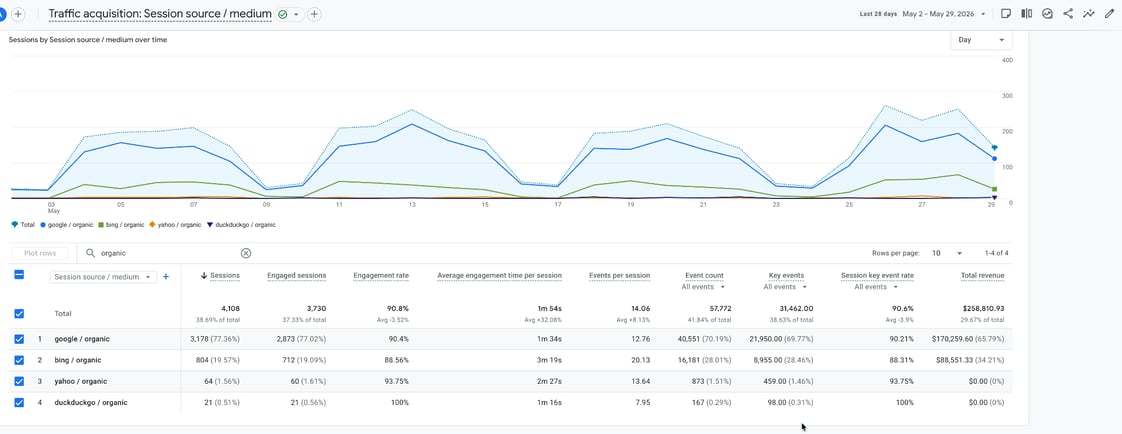
Having Google send almost 90% of your organic traffic isn't a concern when you have that up-and-up traffic pattern.
But Google operates on its own agenda and can make changes to their platform at any time. When those changes happen, your traffic will be affected.
And they have kept making those changes, almost always in the same direction.
Nearly 30% of the clicks Google does give away now go to Google's own properties, like YouTube, Maps and Images, rather than to independent sites.
That dependence on a single channel that quietly rewrites its own rules is exactly why we push clients toward a broader inbound marketing base instead of betting the business on one source.
The clearest example of Google keeping traffic for itself has a name: the zero-click search.
Zero-click search: when Google answers the question for you
A zero-click search is one that ends on the results page itself. Instead of a list of links, Google's in-result answers, AI summaries, knowledge panels, and other SERP features hand people exactly what they came for, so they never visit another website.
These have been coined "zero-click search results" because Google has already given you the information you were looking for.
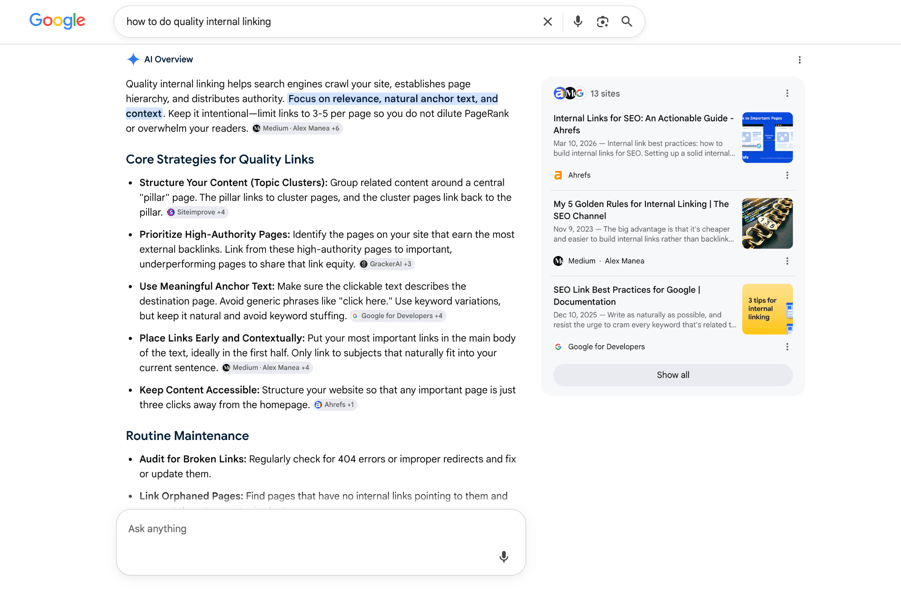
Google will also give you shopping results that go to Google Shopping, flight details on Google Flights, local listings on Google Maps... you get where I'm going with this (I'm going to Google properties, not your site). Google has its own platforms that compete with loads of websites, and it should really be no surprise that Google would eventually want that traffic.
And this has been the trend for years, long before AI entered the conversation. Back in 2020, SparkToro found that about two-thirds of Google searches already ended without a click, and it never really came back down.
SparkToro and Datos now track this every quarter, and their Q4 2025 data shows 56% of Google desktop searches ending in a zero-click outcome.
Google drives a click, paid or organic, for just 44% of searches, down from more than 60% a decade ago, and mobile (which is roughly two-thirds of all Google searches) is worse still.
Read those dates again: zero-click was already beginning to be a norm before Google's AI Overviews even launched in May 2024. AI didn't start this fire, it poured fuel on one that was already burning.
This is a HUGE wake-up call for many web properties that won't just experience a plateau in traffic but could see a sharp decrease if some of their top search queries start resolving on the results page.
Ads crowd out the organic results
Part of the squeeze is simply ads. Google makes money when people click ads, so it has every incentive to show more of them and to push them above the organic results.
On desktop, that stack of ads can fill the entire space above the fold before a single organic listing appears. It's one reason a deliberate paid search presence has gone from "nice to have" to a sensible hedge against shrinking organic real estate.
On mobile, the squeeze is worse
On mobile devices, where search real estate is even more precious, the effect compounds.
Mobile is about two-thirds of all Google searches and carries an even higher zero-click rate than desktop's 56%. When ads and an AI summary take the top of a small screen, the first organic result can sit an entire scroll below the answer, and most people never get there.
So by 2021 the conclusion was already clear: you're not really competing with other web properties for search traffic anymore. You're competing with Google. Everything since has only sharpened that, starting with Google pointing its own AI at the top of the page.
Now you're competing with Google's AI
The biggest shift since this post first ran is the AI Overview, the AI-generated summary Google began placing at the very top of results in May 2024.
By May 2025 it had rolled out to more than 200 countries and 40-plus languages. A knowledge panel answered one factual question; an AI Overview synthesizes a whole topic from several sources and hands it over before the searcher reaches a single organic result.
The effect on clicks is measurable, and it is steep. Pew Research Center tracked real browsing behavior and found that when an AI Overview appears, people click a regular search result just 8% of the time, versus 15% when there's no summary.
Only 1% clicked a link inside the summary itself, and people were noticeably more likely to end their session entirely. Ahrefs, looking at the position-one listing specifically, measured a ~58% drop in click-through rate when an AI Overview sits above it.
It's not subtle in the aggregate, either: zero-click rates climbed notably from March 2025, exactly when Google rolled AI Overviews out widely.
Ranking number one matters far less when number one is buried under a paragraph that already answered the question.
And the AI Overview is still the gentler version of what's coming, because it at least happens on Google, where you can still be seen. The harder shift is when Google isn't in the picture at all.
And now you're competing with ChatGPT and Google AI mode
There's a second front the 2021 version of this article couldn't have predicted. A growing share of the questions that used to start on Google now start in an LLM.
People open ChatGPT, Perplexity, Gemini or Google AI mode, ask in plain language, and get a synthesized answer with a handful of citations, no SERP involved. For those queries there is no ranking position to win and no click to lose, because the search engine was skipped completely.
Here's the part that surprises people, though: this isn't Google collapsing. SparkToro and Datos found that AI tools are mostly additive.
Through 2025, traditional search visits actually grew even as AI tool use jumped roughly 50% year over year, with people using both for different jobs. Google still holds north of 90% of search. That's cold comfort, though, if your customers increasingly start in a tool where there's no SERP to rank on, and the momentum is real: Google's own Gemini climbed from under 5% of US desktop users in late 2024 to nearly 12% by the end of 2025.
This is the logical end of the trend this post has tracked since 2019. First Google kept the click on a small set of queries. Then AI Overviews took it on far more. Now an AI assistant can answer without involving a search engine at all. The job changes either way: the goal is no longer only to rank, it's to be the source the answer quotes. That shift is significant enough that we wrote a separate guide on changing your search strategy for AI.
That's the full picture of the squeeze. The rest of this is what to do about it, starting with figuring out whether you're actually a victim of it.
Is it zero-click, or is your SEO just bad?
Plateauing or decreasing organic traffic is a huge concern when you're an SEO and organic traffic generation is your job. Before you panic, work out which problem you actually have, because the fixes are completely different. A few KPIs will tell you.
Check your SERP features
When you have content that ranks really well and gets a featured snippet, you celebrate and panic at the same time.
Google decided your content was the best of them all, but now your CTR and traffic to your site is going to drop.
That's not a failure. SEO is and always has been about your competitive advantage, and you're going to miss out on some clicks here but so are your competitors.
Your listing has pushed them down even further, and you're far more likely to get a click than they are, even if it's fewer clicks than you used to get. You can track your SERP feature placements with Ahrefs, Semrush and most other rank tracking tools.
Check whether you're being cited in AI Overviews
This is the new version of the same KPI. Being pulled into an AI Overview costs you some clicks the same way a featured snippet does, but it also puts your brand in front of everyone who reads the answer and never scrolls.
Most rank trackers now flag which of your keywords trigger an AI Overview and whether you're cited in it. If your content is feeding the answer, that's visibility worth protecting, even when it doesn't show up as a click.
Check your leads, sales and other conversion markers
Decreasing traffic isn't so bad if you're still getting leads and sales. At the end of the day, isn't this the more important metric?
For many search results, Google isn't sending traffic to your site but is still facilitating the conversion.
Click to call, getting directions, showing your business hours and other contact-type queries can skip the step of coming to your site but still convert with you.
Check Google Search Console
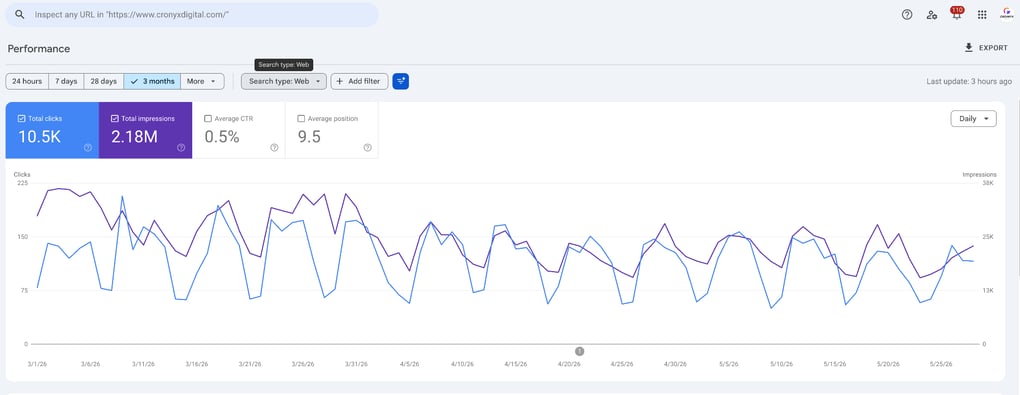
Check whether your search impressions are increasing. If you're getting more visibility, you might be doing something right for SEO.
Impressions aren't a great measure of 'success' on their own though, but they're often a good way to tell whether falling clicks come from lost visibility (a real SEO problem) or from changed user behavior, AI Overviews, SERP features or ads (not your fault).
A rising-impressions, falling-clicks pattern is the classic fingerprint of zero-click, not of broken SEO. If that's what you're seeing, the work shifts from fixing your rankings to competing for the answer itself.
How to win: answer engine optimization (AEO) and GEO
Once you accept that a big share of searches will never produce a click, the work changes from chasing clicks to earning visibility and citations inside the answer.
Two terms get used for this. Answer engine optimization (AEO) is about being the source Google's AI Overviews and featured snippets pull from.
Generative engine optimization (GEO) extends the same idea to ChatGPT, Perplexity and Gemini. They overlap heavily, and in practice you optimize for both at once.
A few things move the needle. Structure content so a machine can lift a clean answer: lead sections with a direct, self-contained response, then expand. Use clear headings phrased the way people actually ask questions.
Most of all, give the model a reason to trust and quote you, with specifics, original data, named sources and genuine expertise, because thin, generic content gets summarized and discarded while distinctive content gets cited.
This is the core of how we approach SEO and AEO for clients now, and it's a meaningfully different brief than ranking a page in 2019.
How to measure success when nobody clicks
If clicks are no longer the whole story, your reporting can't lead with sessions and call it a day.
Track impressions and average position in Search Console to confirm you're still visible, even on queries that don't send a click.
Watch branded search volume, because people who get your answer in an AI Overview often come back later and search your name directly.
Keep an eye on referral traffic from ChatGPT, Perplexity and Gemini as a new line item, since assistants increasingly pass along real visitors.
And then tie it all back to leads and revenue rather than raw traffic. Reframing what you report, and getting your reporting and analytics set up for a zero-click world, is often the single most useful thing an in-house team can do this year.
But what if you've capped out? Market maturity and saturation
If everything checks out, you have good visibility, you're outranking the competition, you have strong desktop and mobile presence, and you're still seeing a drop, it's hard not to panic.
It's even harder to explain it to your bosses and stakeholders, though. At a certain point, the best optimized sites are going to hit their market cap.
If this is you, congratulations. You've leveled up, and you have some new challenges to overcome.
- Conversion rate optimization. How can you improve your site to convert more of the people who do come to it? This is where disciplined conversion rate optimization earns its keep, because every visit matters more when there are fewer of them.
- New audience development. What audiences are you missing out on, and how can you effectively expand your reach?
- Audience engagement and evangelism. What can you do to get your existing audience to be your hype and sell for you?
Is this the end of our organic traffic gold rush?
SEO is about SO much more than just month over month traffic growth. Working with your teams, clients and stakeholders to clearly identify the main business goals, and how you can help achieve them, is what keeps you valuable.
Taking the initiative to talk to them now about how the search landscape is shifting, and how KPIs should be adjusted to align with business objectives, will help you stay a valued asset and avoid difficult questions about organic traffic levels down the road.
The gold rush of easy, ever-growing organic traffic is over. The opportunity isn't, however.
The brands that win the next few years are the ones that stop measuring search purely in clicks and start measuring it in visibility, citations, and conversions, the things that actually move a business in a world where the click is optional.
Note: Not all websites will experience a drop in organic traffic, and many will continue to see strong month-over-month increases. This is very dependent on your vertical, your competition, and the SERPs for the search phrases that are key to your business.

Frequently asked questions
Is SEO dead?
No. SEO has changed, not died. Google still processes billions of searches and most still begin there. What's gone is the assumption that ranking equals traffic. The work now is earning visibility inside AI Overviews, featured snippets and AI assistants, not just ranking in blue links.
What is a zero-click search?
A zero-click search is one that ends on the results page without the searcher visiting another website. Google answers the query directly with an AI Overview, featured snippet, knowledge panel or its own property like Maps. SparkToro and Datos put this at 56% of Google desktop searches in late 2025, and higher on mobile.
Why is my organic traffic dropping even though my rankings are stable?
Usually because clicks are being absorbed before they reach you. If impressions are flat or rising while clicks fall, AI Overviews, featured snippets or ads are answering the query on the page. That's a zero-click pattern, not a ranking problem.
Do AI Overviews hurt website traffic?
Yes, for clicks. Pew Research found people click a result 8% of the time when an AI Overview appears, versus 15% without one. The upside is brand visibility, since your content can be seen and cited inside the answer even when it isn't clicked.
What's the difference between SEO and GEO?
SEO optimizes to rank in traditional search engines. GEO (generative engine optimization) optimizes to be cited by AI tools like ChatGPT, Perplexity and Gemini. AEO (answer engine optimization) sits between them, targeting Google's AI Overviews and snippets. The tactics overlap, so you generally pursue all three together.
How do I optimize for AI Overviews and AI search?
Lead sections with a clear, self-contained answer, structure content with question-style headings and FAQ schema, and give AI a reason to quote you with specifics, original data and named sources. Distinctive, well-structured, trustworthy content gets cited; thin content gets summarized and ignored.
Ready to compete in a zero-click world? CRO:NYX Digital helps teams adapt for AI Overviews and answer engines. Let's get to work.

Other posts you may be interested in
CRO:NYX Digital Is Heading to HubSpot UNBOUND
HubSpot Dashboards for Financial Services
How to Track and Measure AI Impact on Your Website

.png)
.png)
.png)