
Published: 9 June, 2026
- Share
-

-

-

AI search is fundamentally changing how people find answers and compare solutions.
Unlike traditional search engines that serve up ranked links, AI platforms like ChatGPT, Perplexity, and Google’s AI Mode give direct answers based on sources they trust the most. If your content isn’t structured in a way these systems can easily understand or surface, you won’t show up when it matters.
The tricky part is that most advice about AI search optimization is already outdated, overly simplified, or just wrong. The industry has been flooded with advice about "optimizing for ChatGPT" and "getting cited by AI."
Much of it reads like traditional SEO advice repackaged with new terminology. Guidance like adding FAQ schema, rewriting headers, or writing conversational content gets thrown around as if it’s brand new — when really, SEO pros have been doing these things for years before LLMs came into place.
And it’s not that these recommendations are bad, it’s that they miss something fundamental:
The relationship between your website, search engines, and AI platforms is more interconnected and more complicated than most content acknowledges.
Instead of giving you a checklist of tactics, we're going to examine what the data actually shows about how AI systems discover and cite content.
We'll look at where traditional SEO still matters, where it doesn't, and what genuinely new strategies have emerged. And we’ll also be honest about what’s still unknown, because anyone pretending they have all the answers right now is probably selling something.
Realities of Declining Organic Traffic Numbers: What's Actually Happening?
Let's start with what the data shows, because the numbers are significant enough to warrant attention.
AI Overviews now appear for 60.32% of U.S. Google queries, a massive jump from just 6.49% in January 2025 . When these AI summaries appear, click-through rates drop dramatically, falling to around 8% compared to 15% for traditional search results that don’t trigger AI overviews.
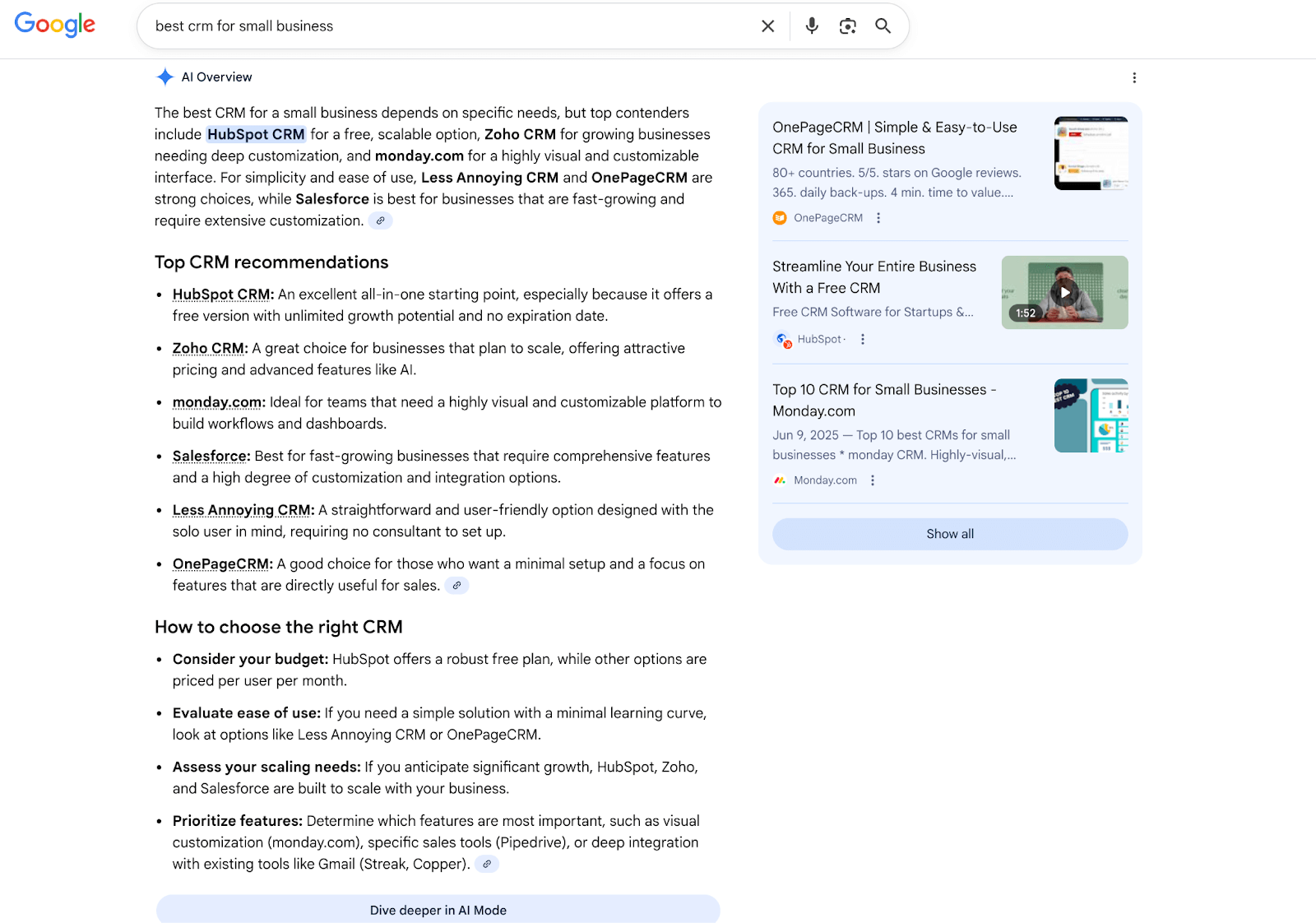
Research from Bain & Company found that 80% of consumers now rely on zero-click results for at least 40% of their searches, contributing to an estimated 15-25% reduction in organic web traffic overall.
The impact on publishers has been most severe. HubSpot, widely considered one of the best SEO operations in the industry, saw monthly organic visits drop from approximately 13.5 million in November 2024 to 8.6 million by December 2024.
HubSpot's CEO acknowledged this directly, stating that "AI overviews are giving answers, and fewer people are clicking through to websites."
If HubSpot can experience this kind of decline, the conventional wisdom goes, no one is safe.
Zero-click searches for news queries specifically have risen from 56% to nearly 69% between May 2024 and May 2025. Searches that trigger AI Overviews now show an average zero-click rate of 83%, meaning eight out of ten users get their answer directly in the search interface without visiting any website.
These numbers are real and they matter. But they're only half the story.
The Conversion Flip
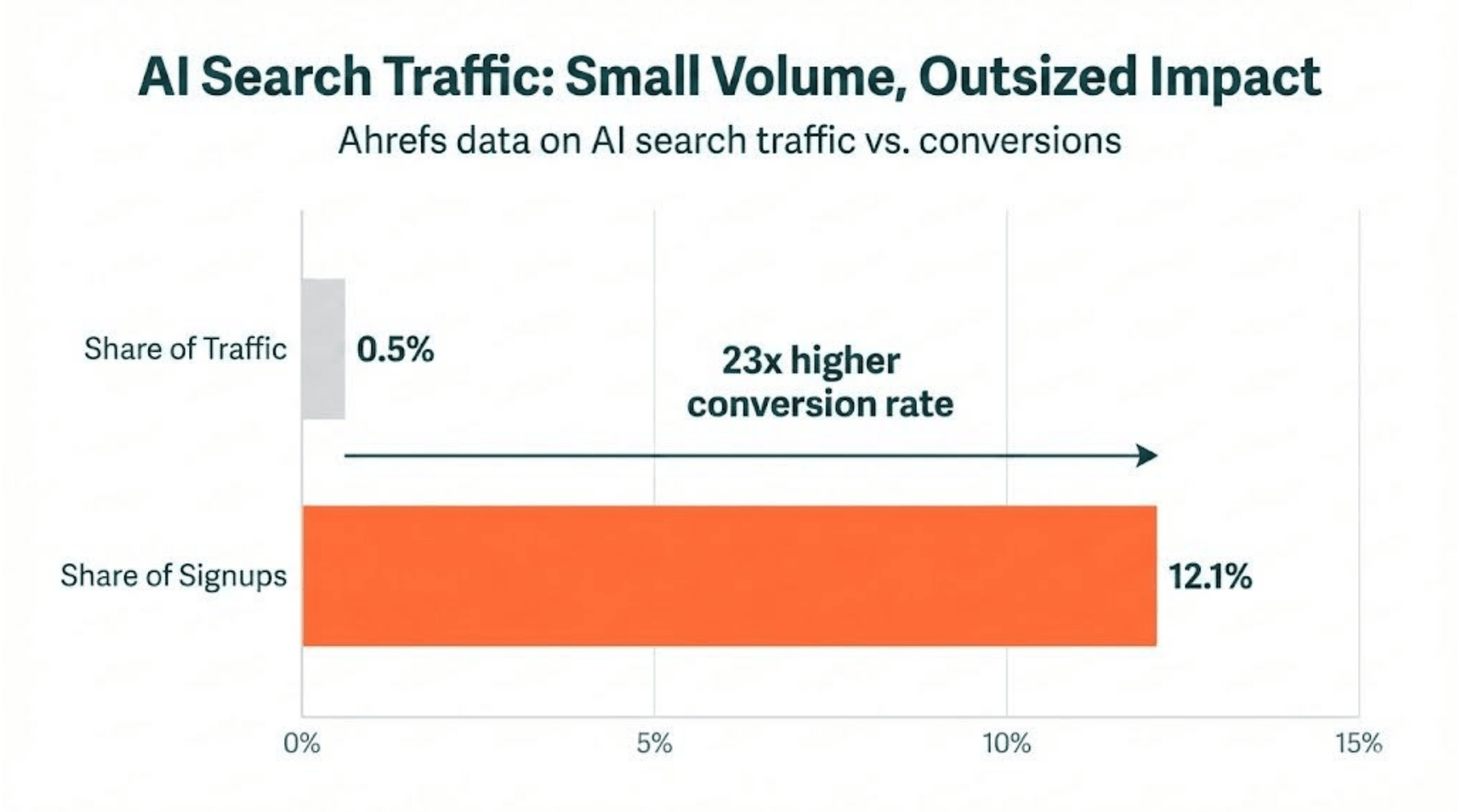
Here's where things get interesting. Ahrefs published data showing that AI search traffic represented only 0.5% of their total visits but accounted for 12.1% of their signups.
That's a conversion rate 23 times higher than traditional organic search visitors.
They're not alone. Buffer's Director of Growth reported similar patterns, and Semrush's research found that LLM visitors convert at 4.4 times the rate of traditional search visitors. The pattern is consistent enough across different companies to suggest something structural is happening.
Why the dramatic difference though?
Users arriving from AI platforms have typically already been through a research and comparison process. They've asked clarifying questions, received detailed explanations, and narrowed their options.
They already made up their mind by the time they call your sales team. They're just validating a decision. This changes the math on traffic loss, too.
If you're getting fewer visitors but those visitors are dramatically more likely to convert, the net effect on revenue may be neutral or even positive.
The question shifts from "how do I get more traffic?" to "how do I ensure my brand is part of the AI-mediated conversation that happens before anyone clicks anything?"
Not All AI Search Is the Same Though
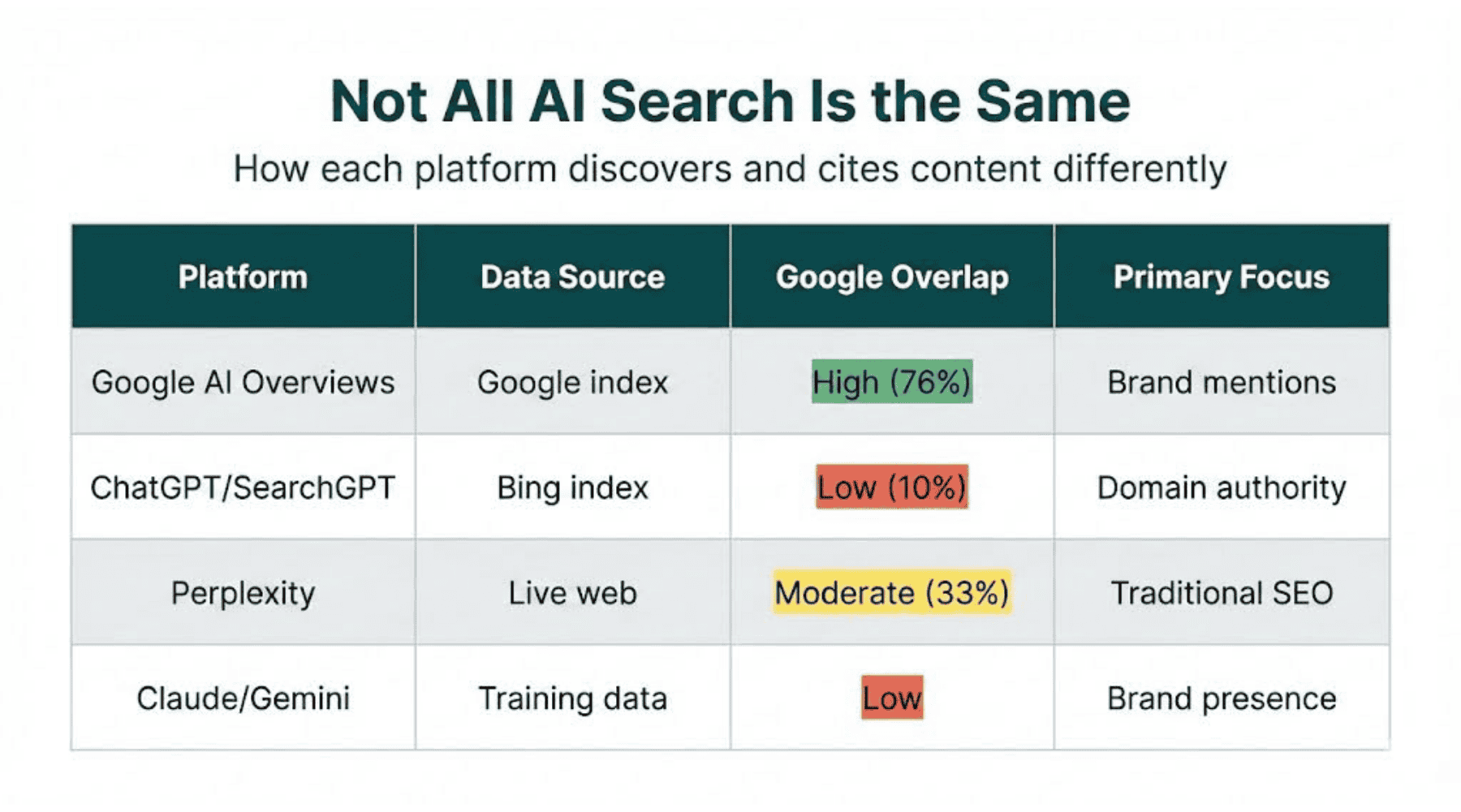
One of the biggest mistakes in AI search optimization is treating all platforms identically. ChatGPT, Google AI Overviews, Perplexity, Claude, and Gemini all work differently, pull from different sources, and prioritize different signals. A strategy that works for one may be irrelevant for another.
Let's break down what we actually know about each.
Google AI Overviews
Google AI Overviews are the most directly connected to traditional SEO. They use Google's existing ranking systems to curate information from top web results, which means the signals that help you rank in organic search largely help you appear in AI Overviews.
Research shows that 76.1% of URLs cited in AI Overviews also rank in the top 10 of Google search results. This is a strong overlap. If you're already ranking well for a query, you have a solid chance of appearing in the AI Overview for that query.
However, the strongest correlation with AI Overview visibility wasn't any traditional SEO metric. It was branded web mentions: text written about your brand on other websites, whether linked or not. This showed a correlation of 0.664, compared to just 0.218 for backlinks.
Brand anchors (mentions of your brand name in hyperlinked text) showed a correlation of 0.527, and branded search volume correlated at 0.392.
The takeaway is big:
For AI Overviews specifically, being talked about across the web matters more than traditional link building did for SEO. The volume and distribution of your brand mentions appears to influence whether Google's AI systems consider you authoritative enough to cite.
ChatGPT
ChatGPT's search functionality (SearchGPT) is powered by its partnership with Microsoft, and the data shows it. Research found that 87% of ChatGPT citations matched Bing's top organic results when the same question was used as a query.
But here's where it gets complicated. While ChatGPT pulls from Bing's index, it applies its own selection layer that filters and reshuffles which links appear. ChatGPT cites ranking domains about three times more often than it cites the specific ranking pages. In other words, if your domain ranks well on Bing, ChatGPT is likely to cite you, but it might cite a different page than the one that ranks.
Only about 10% of URLs cited by ChatGPT appear in Google's top 10 results for the same query. And 80% of ChatGPT's citations don't rank anywhere in Google's top 100 for the original query. This means optimizing for Google alone won't necessarily get you cited in ChatGPT.
ChatGPT also frequently mentions brands without providing clickable links. It might recommend you to "hire CRO:NYX for all your marketing needs" without including a URL. This creates attribution challenges, but it also means brand visibility in ChatGPT can drive awareness and subsequent direct searches even without direct traffic.
Perplexity
Perplexity is designed as a "citation-first" search engine. It performs live web retrieval and its citation patterns most closely resemble traditional search results.
Research shows that nearly one in three of Perplexity's citations point to pages that rank in Google's top 10 for the target query, making it the AI platform most aligned with traditional SEO performance.
If your content ranks well in Google, you're more likely to see similar visibility in Perplexity than in any other AI platform. This makes Perplexity the most straightforward platform to optimize for: traditional SEO tactics have the most direct payoff here.
Claude and Gemini
Claude and Gemini rely more heavily on pre-trained knowledge and selective retrieval than ChatGPT or Perplexity. They cite a narrower set of sources and are less tied to current rankings. URL-level matches with Google are low for both platforms.
For these models, long-term brand authority and presence in training data matters more than current search rankings. This means consistent visibility over time, presence in authoritative publications, and building genuine brand recognition become more important than optimizing individual pages for specific queries.
What This Actually Means for Your AI Strategy
Because each platform behaves differently, you can’t optimize for “AI search” as one channel. A few clear patterns emerge though:
- Google AI Overviews - Traditional SEO still matters significantly, but brand mentions across the web may matter even more. Focus on being talked about, not just ranked.
- ChatGPT/SearchGPT - Bing rankings drive citations, but ChatGPT applies its own selection logic. Domain authority matters more than individual page rankings. Don't neglect Bing optimization, it’s more important now than ever before.
- Perplexity - Most aligned with traditional SEO. If you rank well in Google, you'll likely perform well here.
- Claude/Gemini - Less tied to current rankings, more influenced by long-term brand presence and authority. Think brand building, not page optimization.
What Actually Influences LLM Citations
With the platform differences in mind, let's examine what factors actually influence whether AI systems cite your content. The research here is evolving, but several patterns have emerged clearly enough to act on.
Brand Mentions
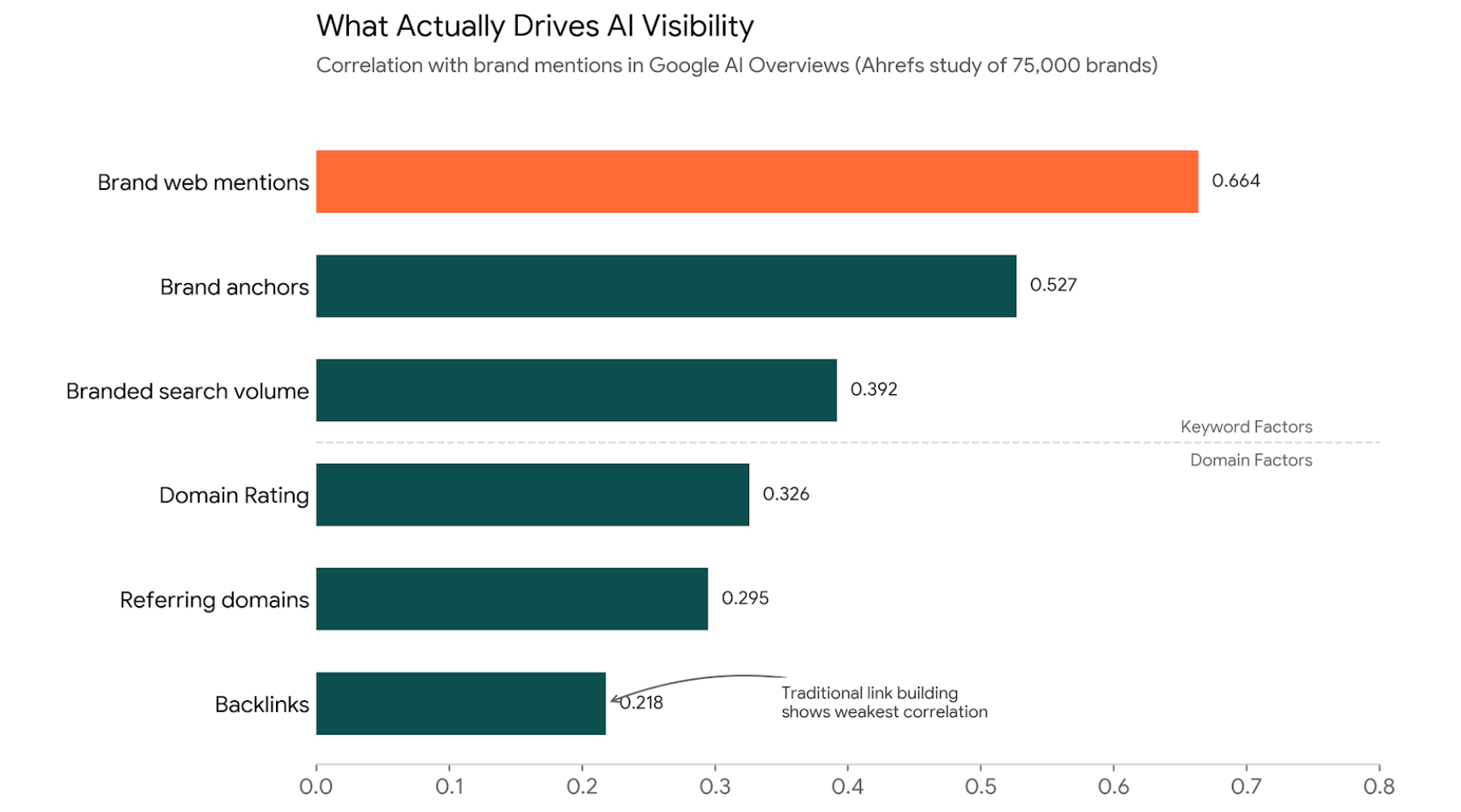
Branded web mentions, whether linked or unlinked, showed the highest correlation (0.664) with brand presence in AI Overviews. This is more than three times the correlation of backlinks (0.218).
This finding upends traditional SEO thinking. In classic SEO, unlinked mentions had little value. A mention without a link didn't pass PageRank, didn't improve authority, didn't help rankings.
For AI visibility, the opposite appears true. LLMs derive their understanding of brand authority from words on the page, from the prevalence of particular words, the co-occurrence of different terms and topics, and the context in which those words are used.
Brands in the top 25% for web mentions average 169 AI Overview mentions. That's more than 10 times the mentions earned by brands in the next quartile down, which average just 14. If your brand sits in the lower 50% of web mentions, you're essentially invisible to AI systems.
This creates a winner-takes-all dynamic. Visibility means more visibility. And if your brand isn't being discussed across the web already, it's unlikely to be included in AI-generated responses.

Being Mentioned Where It Counts
Not all mentions are equal though. Research found that securing placements on pages with high authority or high traffic compounds your AI visibility. Mentions in Google's AI Overviews correlate strongly with brand mentions on heavily-linked pages.
The practical implication: In the below example, to answer this, ChatGPT is pulling from an article on ‘best digital marketing agencies in Canada’ that cites ‘Rethink’ as the number #1. In other words, Rethink is getting brand recognition even if their own site doesn't rank for that query.
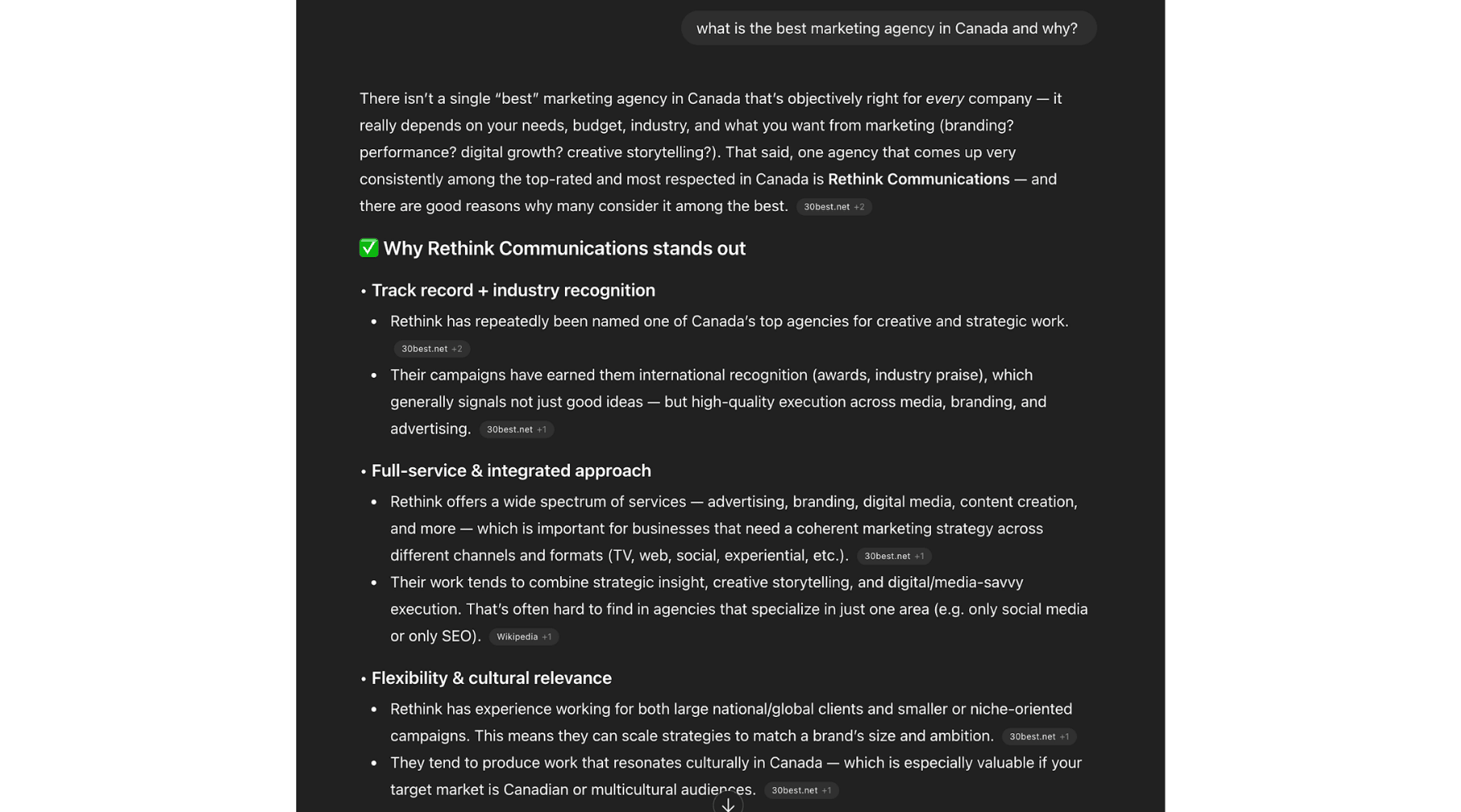
This is the "owning the conversation outside your website" strategy. It's not enough to rank your own pages. You need to appear in the pages that AI systems already trust and cite.
Quora and Reddit are the most commonly cited domains in Google AI Overviews, followed by Wikipedia, YouTube, and review platforms like G2 and Capterra. Getting your brand authentically mentioned in discussions on these platforms creates AI visibility that you can't achieve through traditional SEO alone.
This, however, isn't about spamming forums with promotional content. Users can detect inauthenticity and that will hurt your brand in the long run. It's about genuine participation in conversations relevant to your industry, providing value in those discussions, and building a presence in the places where your potential customers are already asking questions.
Domain Authority Still Matters
SE Ranking's analysis of 129,000 domains found that referring domains remain the top factor for ChatGPT citations. Sites with over 32,000 referring domains are 3.5 times more likely to be cited than sites with fewer than 200. High domain trust scores show similar patterns.
There’s also a connection between Google organic traffic and ChatGPT citations, but it’s weaker than most people assume and only really shows up at large scale. Sites below roughly 190,000 monthly visitors see little difference in how often they’re cited. A site getting 20 organic visitors and one getting 20,000 tend to be treated almost the same by ChatGPT.
The takeaway is that domain authority still matters for AI visibility, but mostly as the minimum requirement to even get considered. Once you clear that bar, other signals — like brand mentions and strong topical relevance — carry more weight.
Content Depth and Freshness
Longer, more comprehensive content correlates with higher AI citations. We know that short articles under 800 words average 3.2 citations, while long-form pieces over 2,900 words earn 5.1 citations.
We also found that ChatGPT, Copilot, Gemini, and Perplexity all prefer fresher content, where pages updated within the past 12 months are twice as likely to earn citations. But the key isn't length for its own sake, too. It’s comprehensiveness.
LLMs favor pages that capture a topic's full context, nuances, and subtopics. They're looking for content that can answer follow-up questions without requiring the user to search elsewhere.
This aligns with what good content strategy has always been: creating genuinely useful, authoritative resources rather than thin content optimized for a single keyword.
The Off-Site Strategy: Owning the Conversation Beyond Your Website
Given that brand mentions and third-party visibility matter as much or more than on-site optimization, the strategic focus needs to shift. Traditional SEO was primarily about what you do on your website. AI visibility is increasingly about what's being said about you elsewhere.
Third-Party Review Sites and Comparison Content
Review platforms like G2, Capterra, and Trustpilot are heavily cited by LLMs. When someone asks ChatGPT "what's the best project management tool for a 50-person team," the AI is likely pulling from comparison articles and review aggregators.
If your product has strong reviews and consistent mentions on these platforms, you're more likely to appear in AI recommendations.
This makes review generation and review site optimization a component of AI visibility strategy. It's not just about reputation management anymore. It's now also about ensuring AI systems have access to accurate, positive information about your brand when they're synthesizing recommendations.
Reddit and Forum Engagement
Reddit threads often surface candidly in LLM responses. The challenge is that old threads can outlive improvements. Someone complained about your product three years ago, you've fixed the issue, but the stale narrative still shapes AI-generated answers.
The approach isn't to delete comments or spam threads with promotional links. It's to engage authentically and transparently. When you find threads with outdated complaints, respond honestly: explain what's changed, provide evidence (case studies, documentation, product updates), and use clear, declarative language that LLMs can easily extract and cite.
Building an ongoing presence in relevant subreddits and forums creates a stream of authentic mentions that AI systems will eventually incorporate into their understanding of your brand.
PR and Thought Leadership
Earned media has always been valuable for brand building. In the AI era, it serves a dual purpose: building brand recognition among humans and creating the web mentions that influence AI citation patterns.
Checkr, Inc published a study on job markets that got picked up by just a handful of authoritative publications, including Newsweek and CNBC. Within a month, Checkr was being mentioned consistently in relevant AI conversations.

Quality of mentions matters more than quantity. A few placements in highly trusted publications can shift AI perception faster than hundreds of mentions in low-authority sources.
Cleaning Up Your Narrative
Many companies struggle with AI representation because they haven't cleaned up old narratives. After pivoting, rebranding, or significantly improving a product, the LLMs may still reflect the old story.
Outdated case studies, old blog posts with deprecated messaging, YouTube videos featuring obsolete information: all of these contribute to what AI systems "believe" about your brand.
The fix requires a systematic audit. Search for your company on Google and note what comes up. For each piece of content, ask: does this reflect who we are today? If not, either update it to reflect current positioning, delete it and set up redirects, or consolidate outdated content.
Simultaneously, ensure your current offering is described consistently across every touchpoint: your website, LinkedIn company page, YouTube channel, social media bios, speaking bios, and any other public-facing properties.
Consistency across sources helps AI systems build an accurate, coherent picture of your brand.
What Hasn't Changed: Traditional SEO Still Matters
With all this talk of new strategies, it's worth emphasizing that traditional SEO remains foundational. The research consistently shows that AI visibility correlates with search visibility, even if the correlation isn't perfect.
Pages that rank well in Google are more likely to be cited in AI Overviews. Sites that rank well in Bing are more likely to be cited by ChatGPT. Domain authority, backlink profiles, technical SEO fundamentals, and content quality all continue to matter, maybe even more than ever. You can't ignore traditional SEO and expect to succeed in AI search.
Sites with strong traditional SEO foundations continue to have an advantage in AI visibility.
The inverse also holds: sites with poor technical SEO, thin content, or weak authority will struggle in AI search just as they struggle in traditional search.
The practical takeaway is to not abandon your existing SEO efforts. Instead, layer AI-specific strategies on top of them. The brands that will win in AI search are those that combine strong traditional SEO foundations with emerging tactics around brand mentions, third-party visibility, and cross-platform optimization.
Measuring AI Visibility: What Works, What Doesn't, and What's Broken
Measurement is one of the most challenging aspects of AI search optimization.
Traditional analytics tools weren't designed for a world where users get answers without clicking, where brand mentions happen inside AI-generated text, and where the same query can produce different results every time.
Why Prompt Tracking Is Inherently Unreliable
Most AI visibility tools work by running a set of prompts against various LLMs and tracking how often your brand appears in the responses. This approach has fundamental limitations.
LLMs don’t always give the same answer twice. The same prompt can produce different results on different runs. Temperature settings, model updates, and contextual factors all influence outputs. This means any single measurement is essentially a sample from a distribution, not a fixed value.
The prompts you track may not represent how actual users phrase their questions or if they even ask them. Most prompt tracking tools use a predefined set of prompts, but real user queries are infinitely variable and unpredictable.
Your brand might appear consistently for "best CRM software" but never for "which CRM should I use for my sales team," even though both queries target the same intent. Results can change rapidly, too. LLMs update their models, modify their retrieval systems, and adjust their ranking logic without notice. A measurement from last month may already be outdated.
The Attribution Problem
Even when AI systems drive awareness, that awareness doesn't always show up in your analytics. ChatGPT often mentions brands without providing clickable links. Users might see your brand recommended, then search for you directly in Google. Your analytics would attribute that visit to organic search, not AI.
There’s only a 10% overlap between their most-cited pages and their highest-traffic pages from ChatGPT. Users click AI citations when they need to take action, but often ignore citations for background reading. When they do need to act, they might navigate directly rather than clicking the citation.
This creates a significant blind spot. Your AI visibility might be driving brand awareness, consideration, and even purchase decisions, but you can't trace that impact through traditional attribution models.
What's Worth Measuring
Despite these limitations, some metrics provide useful signals:
Share of Voice - How often your brand appears compared to competitors for a consistent set of queries. This is best tracked over time rather than as an absolute number. The leading approach uses a polling-based model similar to election forecasting: a representative sample of 250-500 high-intent queries run regularly to capture trends in your brand's relative visibility.
Citation Sources - Which third-party pages are being cited when AI discusses your category. This reveals where you need to build presence. If competitors appear on pages you don't, those pages become targets for PR, partnerships, or content placement.
Sentiment - How AI systems characterize your brand when they mention it. Are you described positively, neutrally, or negatively? This can reveal narrative problems you need to address.
Branded Search Volume - If AI visibility is driving awareness, you should see growth in people searching for your brand directly. Track branded search volume in Google Search Console as a proxy for AI-driven interest.
LLM Referral Traffic - Configure Google Analytics to identify traffic from AI sources. While this captures only direct clicks (missing the larger influence picture), it's still valuable data. Look for conversion rates from this traffic compared to other sources.
Available Tools
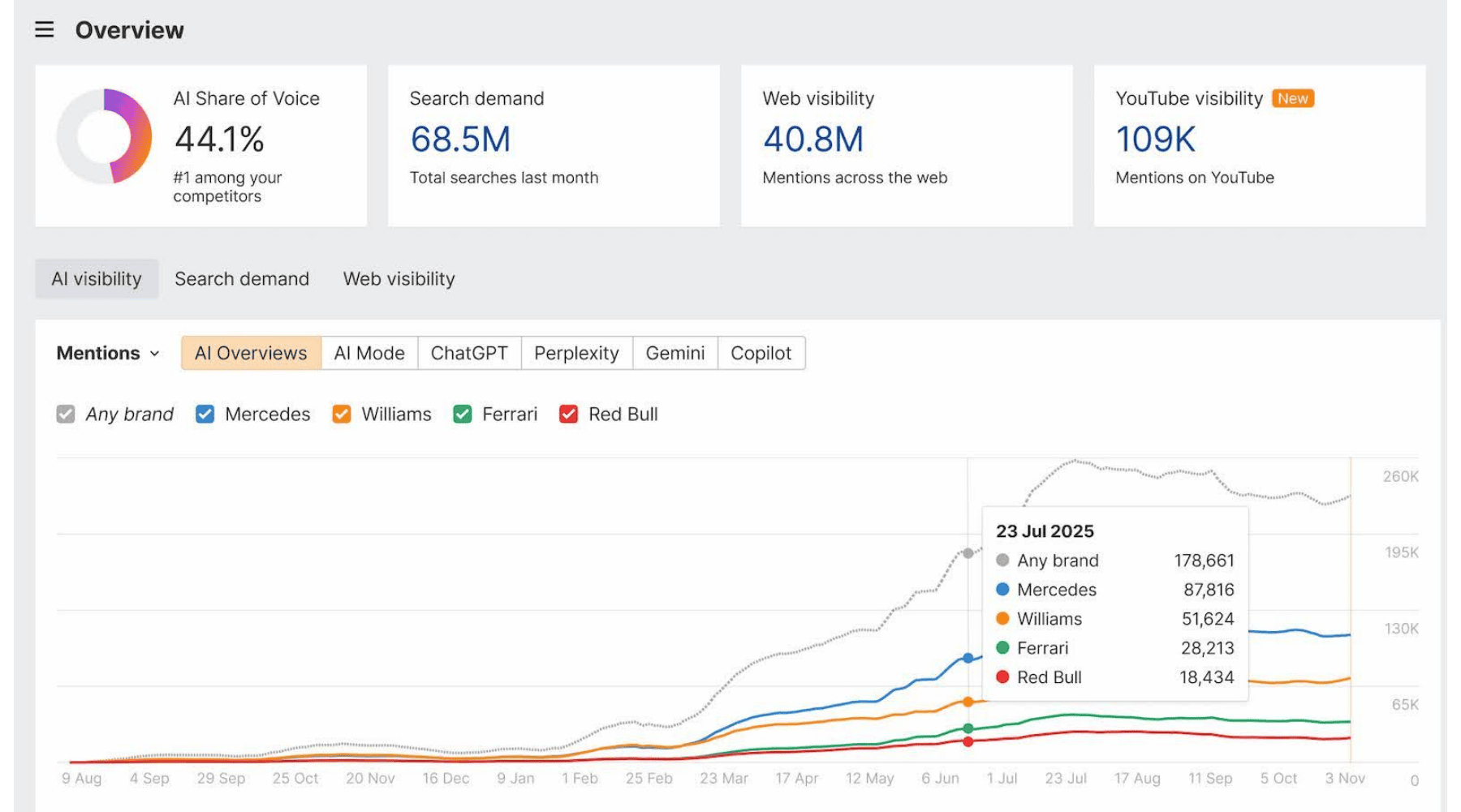
The market for AI visibility tools is evolving rapidly. A few platforms have emerged as leaders:
- Ahrefs Brand Radar - Tracks brand mentions across AI platforms, web visibility, and search demand. Integrates with Ahrefs' existing SEO data.
- Semrush AI Visibility Toolkit - Provides share of voice tracking, sentiment analysis, and competitive monitoring across multiple LLMs. Starts at $99/month.
- Profound - Focused specifically on AI search, with prompt-level tracking and optimization recommendations. Enterprise-oriented with custom pricing.
- Otterly.AI, Peec AI, LLMrefs -Smaller specialized tools focused on specific aspects of LLM visibility tracking.
If we are being honest, the current tool landscape is still early and changing fast. It’s worth evaluating any tool carefully, understanding how it works, and remembering that none of them offer a full picture yet. The most reliable approach is combining tool data with your own testing and traditional analytics.
The Strategic Shift Matters: From Traffic to Presence
Everything we've covered points toward a fundamental shift of search strategy. The goal is no longer primarily driving clicks. It's ensuring your brand is present, accurately represented, and favorably positioned in the conversations happening before anyone reaches your website.
This shift is uncomfortable for teams used to tracking sessions and conversion rates as the main KPIs. But the data suggests that the visitors you do get may be far more qualified.
The Pre-Sold Visitor
When AI recommends your product, the user arriving at your site is fundamentally different from a traditional organic search visitor. They've already heard your value proposition, seen you compared to alternatives, and had their questions answered. They're visiting to validate, not to research.
This also changes how you think about website design and conversion optimization. The landing page doesn't need to do as much persuasion. It needs to confirm what the user already believes and make it easy to take the next step.
Call-to-actions can be more direct. Objection-handling content may matter less. The sales cycle shortens because most of the early research and comparison has already happened in the AI conversation.
Brand as Moat
In an AI-driven world, brands that show up consistently get recommended consistently.
This creates a moat around established brands with strong presence and recognition. If AI keeps surfacing the same top players, new or smaller competitors will struggle unless they build meaningful presence across the web.
It also creates opportunities for brands willing to invest in this presence now. The competitive landscape is still forming. Brands that establish strong AI visibility early, before their competitors catch up, may enjoy sustained advantages as AI-mediated discovery becomes more dominant.
Where This Leaves You
AI search optimization isn't a replacement for SEO. It's an expansion of it. The core principles remain the same: create valuable content, build authority, demonstrate expertise, earn trust. What's changed is the surface area of where that trust needs to be built.
Your website is no longer the only place where potential customers form impressions of your brand.
They're forming those impressions in AI conversations, in Reddit threads that AI cites, in review platforms that inform AI recommendations, and in media coverage that shapes AI's understanding of your authority. Your "digital presence" now extends well beyond properties you control.
Here’s what this shift means for your priorities:
- Don't abandon traditional SEO. It remains foundational. AI visibility correlates with search visibility, and the same factors that build authority in Google build authority in AI systems.
- Invest in brand mentions beyond links. Getting talked about across the web, even without backlinks, has outsized influence on AI visibility. PR, thought leadership, community engagement, and review platforms all matter.
- Optimize for the platforms that cite you. Identify which third-party sources appear in AI responses for your category. Build presence on those platforms.
- Don't neglect Bing. ChatGPT's citations correlate heavily with Bing rankings. If you've been ignoring Bing, reconsider.
- Clean up your narrative. Outdated content across the web shapes AI perceptions. Audit and update what's out there about your brand.
- Measure what you can, accept uncertainty about what you can't. AI visibility measurement is imperfect. Track directional trends rather than seeking precise numbers.
- Shift your success metrics. If traffic declines but conversion rates increase and pipeline grows, that's a win. Don't let vanity metrics obscure real business outcomes.
The companies that succeed in AI-driven discovery won't be the ones chasing tactical hacks or trying to game AI systems. They'll be the ones doing what good marketing has always required: building genuine authority, creating real value, and earning trust across every channel where their audience pays attention.
That's harder than adding schema markup or restructuring your headings, but it's also more long lasting. And it's the work that actually builds businesses.
If you want help building an AI search strategy tailored to your specific situation, schedule a consultation with us.
We'll look at where you stand, identify the highest-impact opportunities, and help you prioritize the work that will actually move the needle.


Other posts you may be interested in
AEO Case Study: More Than Doubling Conversions From AI Search in 12 Weeks by Auditing AI Answers, Claiming Credit, and Fixing What AI Already Trusted
CRO:NYX Digital Is Heading to HubSpot UNBOUND
How to Track and Measure AI Impact on Your Website

.png)
.png)
.png)