Published: 9 October, 2026
- Share
-

-

-

Our client, a US manufacturer that makes products for healthcare and consumer brands, had a small channel (AI traffic) doing more than its share. AI tools were sending them their best-converting visitors, but mostly when buyers already knew the name of the client.
In the 12 months before we started, AI tools brought in 2.4% of the site's traffic and 8.6% of its conversions.
AI visitors also converted at 10.8%. Organic search converted at 3.2%.
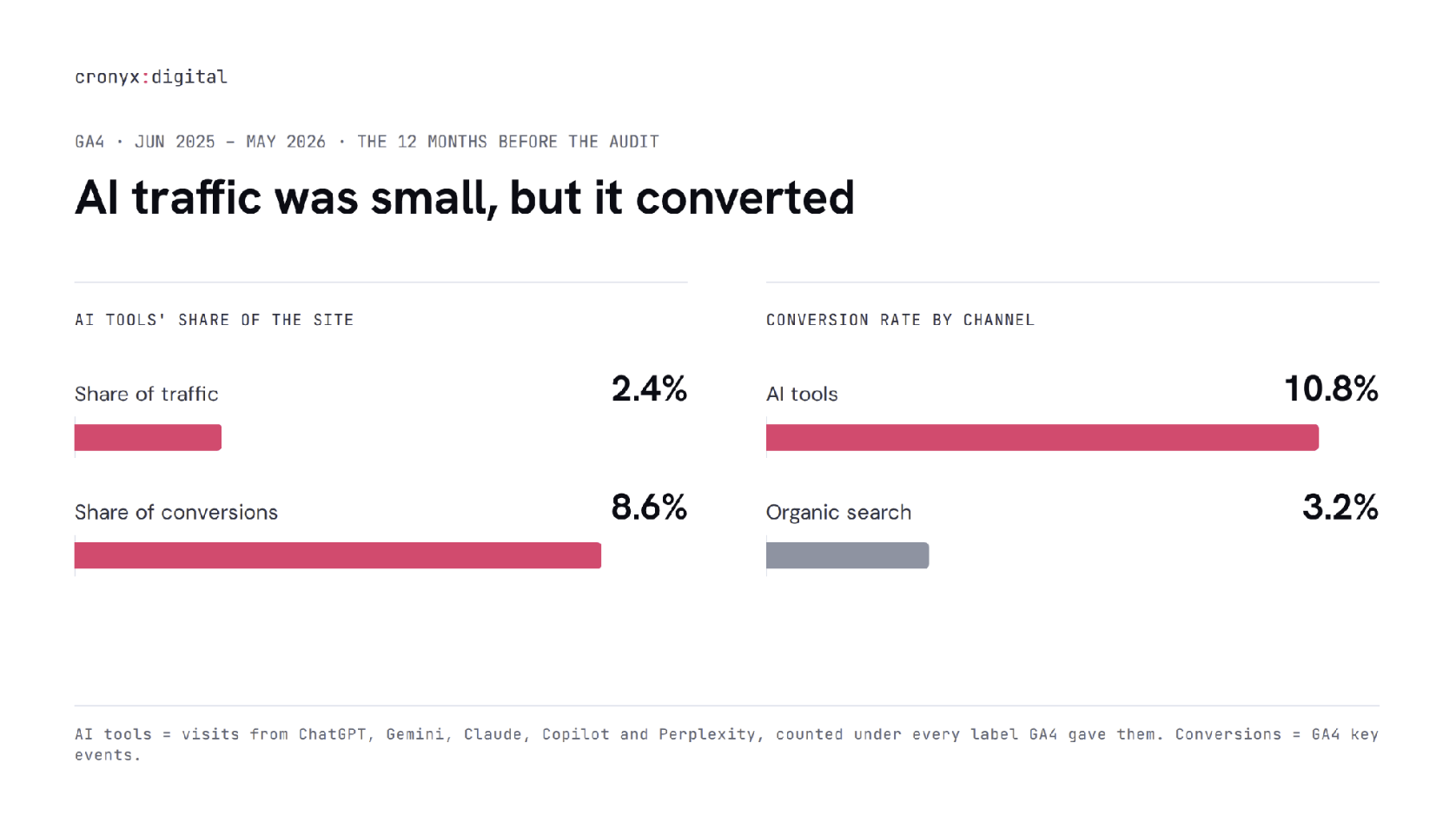
Small channel but a big conversion rate. The obvious question was how to get more of it, and nobody could answer that without first knowing how AI was actually talking about the company.
The Challenge: AI would vouch for them, but it wouldn't volunteer them.
Established B2B companies run into this a lot in AI search. Years of solid SEO give AI tools plenty to read about you, so when someone asks about you by name, the answer is accurate and positive.
But buyers early in their search don't ask about you. They ask about their problem: who can make this in the US, which material is safer, what's a typical minimum order. The answer gets built from whoever wrote the clearest content about that problem, with their name attached.
This is where SEO stops being about ranking one page for one keyword and becomes about being named. AI has to connect your content to your company, and you need an answer ready for the questions buyers ask before they know any names.
Our Approach: SEO, With an AEO Layer on Top
What we had: A manufacturer with solid SEO, a website that AI cited more than any other in our test, and a brand that AI mostly recommended to people who already knew it.
What we did:
- Ran 150 real buyer questions through ChatGPT, Google AI Overviews and Google AI Mode, and mapped every brand named, every URL cited, and where the client sat in each answer.
- Tied each finding back to their own data: 12 months of Search Console, GA4 conversions and a full site crawl.
- Added the brand to the content AI was already quoting without naming them.
- Rebuilt key pages in the shape AI already likes to cite.
- Started building new pages to get the client in the “conversations” they weren’t part of.
- Set up measurement that tracks AI traffic under every label GA4 has used for it, including the months before Google added an AI channel.
The Audit: 150 questions, 3 engines, 449 answers
We wrote 150 questions the client's buyers actually ask. They came from three kinds of buyers: a founder with a product idea and a prototype in hand, a sourcing lead trying to move production out of China, and an engineer specifying components. Each question went through ChatGPT, Google AI Overviews and Google AI Mode on the same day.
We captured all 449 answers: the full text, every brand named, every URL cited, and where the client appeared.
When the question included the company's name, AI mentioned them in 71 of 72 answers.
When it didn't, they showed up in 55 of 377.
92 of the 150 questions never mentioned them in any engine.
Ask AI about the company and it said good things. Ask it who to call and the company rarely came up.
The audit also turned up two gaps. When we asked who owns the company, ChatGPT without browsing asked us which company we meant, while both Google engines answered perfectly. And AI didn't connect the client to the consumer products they've been making for years. Not one of 9 answers made that link.
Cited, Not Named: AI was quoting their content without saying their name
The client's website was the most-cited domain in the whole audit: 260 citations across 66 questions, ahead of YouTube (131) and Reddit (97).
But in 27 answers, AI cited one of their pages and never said the company's name. All 27 came from Google's engines. Their blog had written the textbook everyone quoted, with no name on the cover.
The posts were written in a neutral, textbook voice, and nothing near the quotable passages tied the facts to the company. So AI took the facts and left the brand behind.
The fix was mechanical, not creative. Each post got three small edits:
- The company name and a first-person claim in the first 200 words.
- Headings that name the company where it fits.
- A short context block that ties the content to the company's real work.
Nothing else on the posts changed. They were getting cited because they were useful, so every edit added something and nothing was taken away. We weren’t going to break what AI (and Google for that matter) already liked.
One Page Proved the Playbook
The client’s most-cited pages all had the same shape: dense with specific facts, structured around questions, with the company named in plain statements. One of their product pages had recently been rewritten that way for SEO purposes, specifically. It jumped to the second most-cited page on the site in one cycle, with 24 citations.
Meanwhile, their main service page, with around 81,000 Google impressions a year, had exactly one AI citation.
So instead of guessing what AI wants, we took the pattern that was already working on their own site and started applying it to the pages that matter most for new business.
That meant FAQ sections in buyer language, real numbers like hardness ranges, production volumes and equipment, the company named in the first 100 words, and internal links from the pages AI already cites.
The Results: AI Conversions More Than Doubled in 12 Weeks
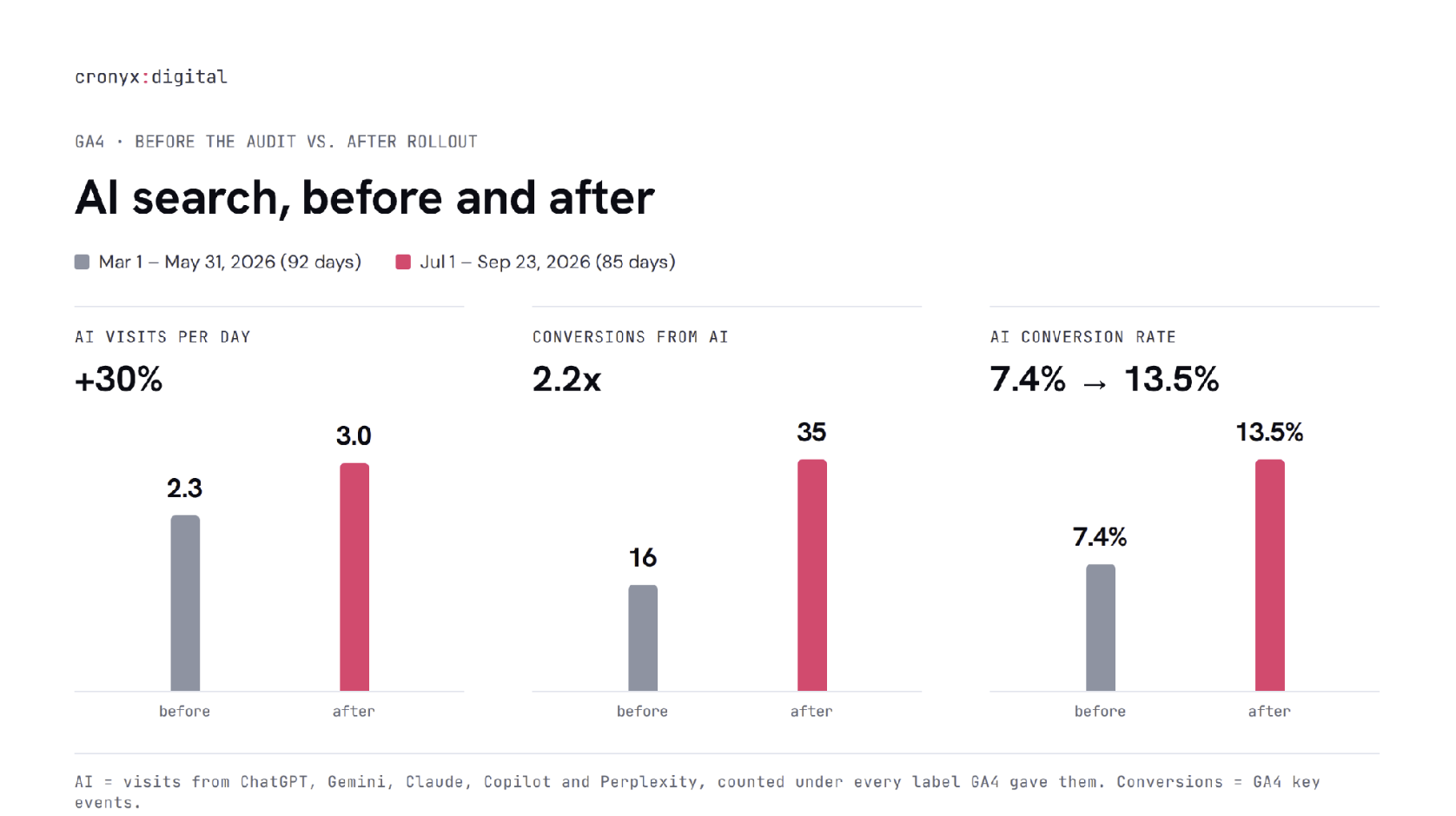
GA4, March 1 to May 31 vs July 1 to September 23, 2026.
Comparing the 12 weeks since rollout (July 1 to September 23) with the three months before the initial audit and implementation (March to May):
- Conversions from AI more than doubled, from 16 to 35, in a shorter window
- Average daily AI traffic to the website grew 30%
- The AI conversion rate went from 7.4% to 13.5%
- From June to September, AI brought in 3% of the site's traffic and 14% of its conversions
- About 1 in 7 AI visitors converted, vs 1 in 28 from organic search
GA4, June 1 to September 23, 2026.
Keep in mind that we are not meticulously tracking whether each prompt actually mentioned the client or not, every single time (we are talking about a non-deterministic system here).
And it’s not because that part is useless, but we really only want to look at the bottom line. Do people using ChatGPT and other AI search platforms actually end up on the website and take the action we need them to take?
These are also small numbers, and 12 weeks is early. Some AI visits, like clicks from the ChatGPT app, arrive with no source at all and land in Direct, so the real numbers might be higher than what we can count.
So just know that we're treating this as a strong early signal, not necessarily a finished result.
Why it worked: we fixed what AI already trusted first
Most AEO advice starts with "publish more content" and it’s not necessarily wrong, but we started with the content AI was already reading.
The audit showed the client didn't have a huge visibility problem. They had a credit problem and a coverage problem. The credit problem could be fixed on existing pages with small edits that only added to them, which is why results showed up in weeks, not quarters.
AEO Is Never Done: What's Next
The coverage problem is the bigger opportunity, and it's where the work is moving next.
We asked AI 8 versions of questions like "manufacturer that also packages and ships." Across 3 engines, that's 24 answers, and no manufacturer claimed the answer in any of them.
AI filled the space with fulfillment-company listicles and marketplaces. This client makes, assembles, packages and ships from one building, so that answer should be theirs.
In their priority vertical, they showed up in 2 of 16 questions. Most of those answers came from overseas factories’ content, including one factory’s own list of the "top US manufacturers."
The website isn't the only place that matters. YouTube and Reddit were among the most-cited sources in the audit, including Reddit threads of buyers asking for exactly what this client does. The client didn't appear in any of them.
For ChatGPT specifically, a lot of the fixes happen off the website. The same accurate facts about the company need to appear everywhere its name shows up, so the model learns who they are.
The summary
The throughline is simple: in AI search, the first win isn't necessarily new content. It's making sure AI connects the content you already have to your name.
If you're wondering how your company shows up when buyers ask AI, that's exactly the kind of problem we like to untangle. And we're always happy to talk it through.

Other posts you may be interested in
CRO:NYX Digital Is Heading to HubSpot UNBOUND
How to Track and Measure AI Impact on Your Website
.png)
Case Study: Increasing Organic Search Revenue 7x by Reducing Indexing, Using Templates, and Putting Structure First

.png)
.png)
.png)